


From Yolanda Relief to State Harassment: Standing with LCDe and Community Responders

For decades, the Leyte Center for Development Inc. (LCDe) has stood alongside poor, marginalized, and disaster-impacted communities across Leyte and Samar provinces in the Eastern Visayas Region, Philippines. Following the unprecedented devastation of Super Typhoon Yolanda (Haiyan) in 2013, in the first four months after the super typhoon, LCDe was among the humanitarian civil society organizations (CSOs) that quickly responded. LCDe stepped in to deliver immediate emergency relief, reinforce local community leadership, and lead long-term recovery and disaster resilience programs. About 23,000 families from 11 municipalities were served. LCDe distributed food, shelter kits, houses, and cash for work.
Super-typhoon Yolanda claimed over 6,300 lives – according to government estimates but thousands more remained uncounted. It damaged ₱95.4 billion worth of infrastructure and loss in livelihoods and incomes. Over a decade later, government recovery efforts remain deeply flawed: audit reports reveal that while 176,804 housing units (91.04% of the target) have been constructed, 47,139 (24.27%) sit empty and unused, and 17,391 (8.96%) remain incomplete.
Furthermore, bureaucratic bottlenecks stalled turnover, taking local governments anywhere from 205 to 3,644 days nearly ten full years to hand over units to displaced families. As communities mark the 13th anniversary of the disaster, intensifying threats of the global climate crisis and Super El Niño, state neglect, corruption, and misaligned spending continue to compound the risks faced by marginalized Filipinos living without safe shelter and sustainable livelihoods.
Development NGOs and people’s organizations (POs), like LCDe have consistently filled the critical void left by state assistance, serving as an indispensable lifesaver across Eastern Visayas when official mechanisms delay or fail. By promoting social justice, climate equity, and community-led disaster preparedness, development workers provide basic security to vulnerable coastal and agrarian populations facing severe environmental crises.
Yet, instead of recognizing essential humanitarian initiatives, the Philippine government has frustrated CSOs’ development work with the weaponization of counter-terrorism measures and regulatory mechanims, such as the Anti-Terrorism Law of 2020 (ATA) and the Terrorism Financing Prevention and Suppression Act of 2012 (TFPSA); to intimidate, red-tag, and criminalize CSO work, development workers and human rights defenders alike. This systemic repression directly targets organizations like LCDe, where the Anti–Money Laundering Council (AMLC), directed the freezing of personal and organizational accounts connected to LCDe, including the personal accounts of its Executive Director, Jazmin Jerusalem and LCDe staff including their families. Although courts dismissed criminal charges on terrorism financing against LCDe due to massive evidentiary gaps and lack of proof; and, ordered the lifting of the temporary asset preservation order, legal harassment continue. LCDe, its officer and staff still face civil forfeiture court proceedings scheduled starting November 12, 2026.
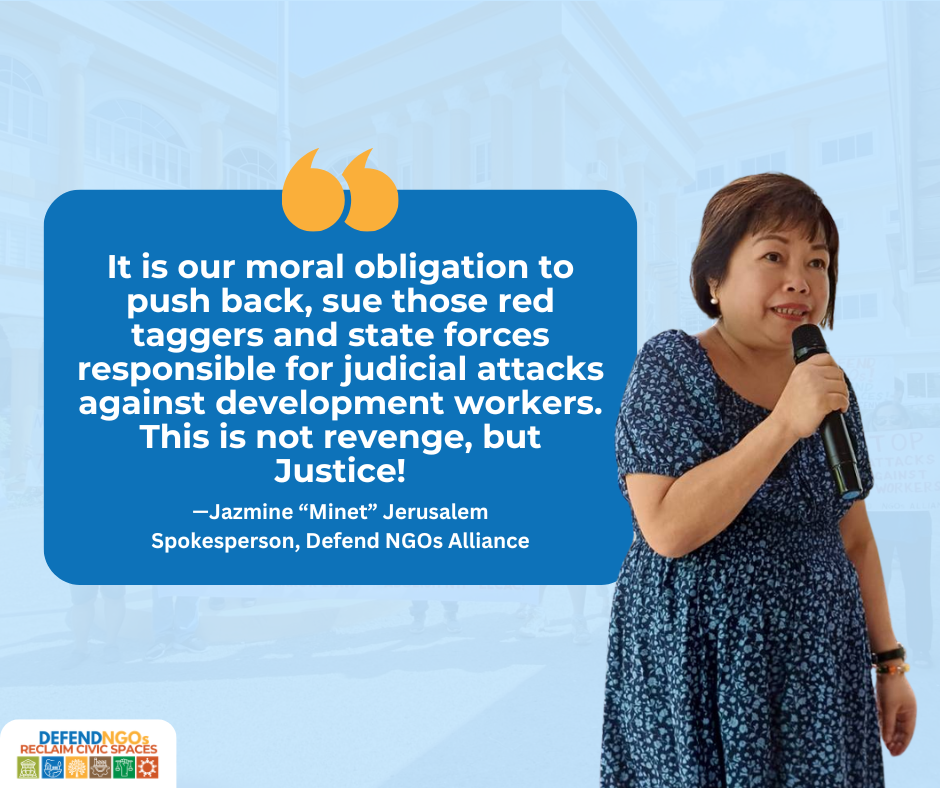
“The delay of the houses meant for Yolanda survivors is an example of the rotten system. Many housing projects have been reported accomplished but still not fit to live in. LCDe, with its German partner Diakonie built 600 houses, and they are still lived in today, 13 years after Yolanda. This is the kind of service that we envision for our people—swift, relevant, attuned to the people’s needs and ensuring dignity while alleviating suffering. And yet the fascists respond to us development and humanitarian workers with attacks in many forms. This is so absurd! But we must not lose hope, continue with courage despite being under fire,” said Jazmin Jerusalem, LCDe’s Executive Director and Defend NGOs Alliance Spokesperson, when asked about government response towards the Yolanda victims and prevailing attacks on development workers that assist in disaster recovery.
The arbitrary freezing of LCDe’s bank accounts has severely crippled its operations, forcing the temporary suspension of vital community initiatives. Trumped-up legal prosecutions directly weaken the social safety nets that keep disaster-prone communities afloat, demonstrating that honoring Yolanda’s survivors requires an immediate end to red-tagging, the unfreezing of humanitarian assets, and true structural accountability for climate justice.
The Defend NGOs Alliance stands in solidarity and full support for LCDe, Ms Jazmin Jerusalem and staff, their families; all CSOs facing various forms of harassments including the communities they serve in asserting their rights. We urge the Philippine government to honor its commitments in upholding the Filipino people’s human rights. #


Comments